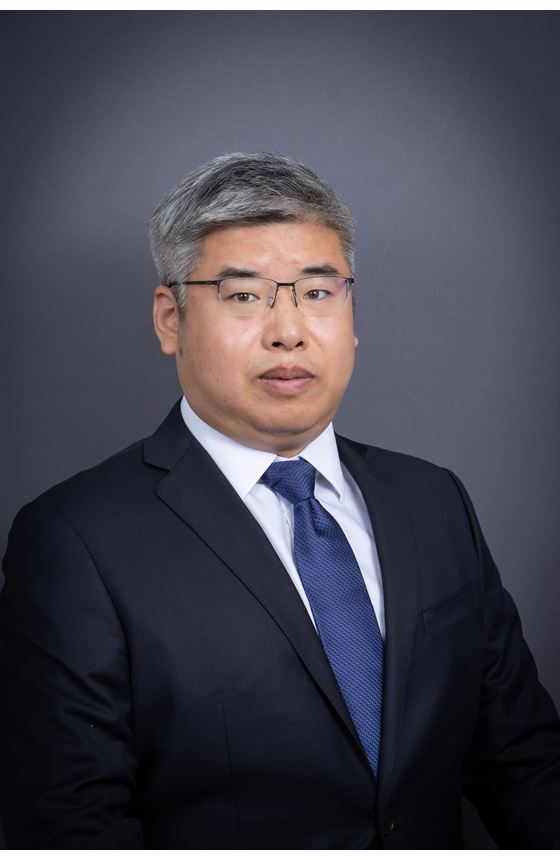
Professor Haitao ZHAO
.jpg?bc=ffffff&h=860&w=560&rev=39bde438a64f4059a10b95c4ad550ce7&hash=B005D3581AEA5914057C5A6AF96C2985)
About Material Intelligence
Material Intelligence (MI) is a type of interdisciplinary technology concerned with making material synthesis work in an intelligent way by artificial intelligence and robotics, similar to the way that the scientists mind and hands works and even beyond.
Artificial intelligence (AI) is technology that enables computers and machines to simulate human learning, comprehension, problem solving, decision making, creativity and autonomy. -IBM
Biography
Professor Zhao obtained his BEng degree (First Class Honours) from Nanchang University in 2010, followed by an MSc and PhD from the University of Nottingham in 2011 and 2015, respectively. His academic career includes significant positions at Zhejiang University, the Massachusetts Institute of Technology (MIT), and the Shenzhen Institutes of Advanced Technology, Chinese Academy of Sciences.
Professor Zhao’s research focuses on Material Intelligence, where he integrates robotics, artificial intelligence (AI), and the other data-driven methodologies. His work aims to revolutionise traditional material R&D by developing Robotic Factory (Hardware), powered by an advanced AI Factory (Software). The overarching framework includes large language models guided rational design (‘Extraction’), robotics-enabled controllable synthesis (‘Execution’), a domain-specific model facilitated learning and generating (‘Evolution’) and embodied intelligence powered autonomous cycles of Extraction-Execution-Evolution, to accelerate the creation of novel materials (energy materials, civil engineering materials,semiconducting material, superconducting materials,etc. with foucing on formulas and parameters)
With over 100 peer-reviewed publications (citations: 8223, h-index: 52, i10-index: 99), Professor Zhao has authored ground-breaking paper such as ‘A robotic platform for the synthesis of colloidal nanocrystals’ in Nature Synthesis and invited review paper such as ‘Data-Driven Materials Innovation and Applications’ in Advanced Materials. His research has been funded by various prestigious bodies, including: Pioneer Hundred of the Chinese Academy of Sciences (Data-Driven Energy Materials Innovation), National Natural Science Foundation of China (Robot-assisted Programmable Digital Manufacturing of Colloidal Metal Nanocrystals), Pearl River Talents of Guangdong Province (Digital and Intelligent Design of Nano-Materials), Natural Science Foundation of Guangdong Province (Intelligent Manufacturing of Nanocrystal Materials), Shenzhen Natural Science Foundation (Robot-assisted Intelligent Manufacturing of Semiconductor Materials), Tencent Open Research Fund (Application of Machine Learning in Robotic Platforms).
Professor Zhao’s research has led to the publication of an invited book with Wiley, Materials Intelligent Manufacturing, and the creation of two IEEE standards: P3466 (Data-Driven High-throughput Laboratory Intelligence and Automation) and P3467 (Digital Manufacturing and Stability Testing of Perovskite Solar Cells and Modules). He currently serves as an Editor for Artificial Intelligence Chemistry and a Young Editor for InfoMat and Results in Engineering.
In addition to his academic work, Professor Zhao is the founder and chair of the International Conference on Data-Driven Materials Innovation and plays an active role in various professional societies and standardisation agencies, including the IEEE Smart Manufacturing Standards Committee, IEEE SA Regional Group of the Guangdong-Hong Kong-Macao Greater Bay Area, and the Guangdong-Hong Kong-Macao Greater Bay Area Standard Innovation Alliance. He is also a Registered Senior Standardisation Engineer in Hong Kong and Guangdong Province.
About Research Centre for Materials Intelligent Manufacturing
The Research Centre for Materials Intelligent Manufacturing (RCMIM) is dedicated to revolutionizing traditional material R&D through cutting-edge interdisciplinary research of material intelligence by artificial intelligence and robotics.
“To achieve Material Intelligence, we begin with the power of Artificial Intelligence—harnessing its ability to learn and generate complex material formulas and synthesis parameters. From the cyber world to the physical world, Machine Intelligence evolves into Embodied Intelligence through the convergence of Artificial Intelligence and robotics, endowing Material Intelligence with unique capabilities for autonomous high-throughput synthesis and in situ characterization. Ultimately, our goal is to achieve code to materials.” – Professor Haitao ZHAO, Director
Research Interests:
Embodied Intelligence, Machine Intelligence, and Material Intelligence
Open Positions
We are looking for motivated talents to join us. Openings for postdocs, graduate students and undergraduates are available.
Contacts
CD633, 6/F, Research Centre for Materials Intelligent Manufacturing Hong Kong Polytechnic University, Hung Hom, Kowloon, Hong Kong S.A.R. Email: hai-tao.zhao AT polyu.edu.hk